
Time & Money: A Story About Switzerland & The Gulf.
You never really own a Patek. You merely look after it for the next generation. Never has a single sentence ever so accurately and succinctly surmised the ethos of an entire nation. Superpowers have risen and fallen, crises have occurred, bubbles have burst; but the Swiss have endured. While the value of both money and time were being eroded by the rest of the world, a small, frigidly cold, austere and aloof country has discreetly co ntinued its work in preserving the two.
Businesses don’t last, families do.
There is a rather unsettling observation that appears again and again in the study of enterprise: institutions that appear formidable in their own time rarely endure beyond a century. The great commercial houses that dominate markets, influence legislation, and command public imagination often find that within two or three generations they have either been dissolved, absorbed, or quietly diminished.
Researchers in corporate longevity have noted that the average lifespan of large corporations is scarcely more than a few decades; even those that survive to celebrate a hundred years are statistical exceptions rather than the rule.
At the same time, scholars of family enterprise have long discussed a parallel pattern within private wealth. A considerable body of research, frequently cited in leading business schools and family governance programmes, suggests that a significant majority of family fortunes dissipate within three generations; the explanation is rarely financial alone, but cultural, psychological, and structural. (The 100 Year Old Business - Martin Reeves)
Capital accumulated through discipline and risk becomes diffuse when its architecture is informal; ownership fragments; responsibility dilutes; clarity of purpose fades. What begins as a coherent economic organism gradually becomes a collection of accounts.
The question, therefore, is not simply how wealth is created, but how it is held in a manner that resists entropy. De Geus argued that most companies focus too narrowly on quarterly profits and short-term competitive strategy. They lose sight of what really sustains long life: the ability to learn, innovate, preserve identity, and adapt to change. These are attributes of a living organism, not a machine; and they’re precisely the qualities families need if they want their legacy to endure. (The Living Company by Arie de Geus [Harvard Business School Press 1997])
If businesses decay through overexposure to markets and internal drift, and if private fortunes erode through informality and diffusion, then durability must lie not in intensity but in structure.
Wealth that is meant to endure must be placed somewhere that recognises time as an ally rather than an adversary.
It is for this reason that, since the nineteenth century, families in the Middle East have looked toward Switzerland. The attraction has never been theatrical; it has been constitutional. Political neutrality, a long tradition of private banking, and a deeply rooted respect for financial discretion created an environment in which capital could be positioned outside immediate turbulence.
Over time, this matured into a sophisticated ecosystem of Swiss fiduciary services, Swiss trustee services, and wealth structuring Switzerland practices that were designed not merely for transactions but for continuity.
In Switzerland, a family business is a family’s business.
In order to understand why a Swiss single family office may operate without prudential regulation in circumstances where it serves only one family’s own assets, one must begin not with finance, but with philosophy.
Switzerland has long drawn a deliberate distinction between activity that touches the public and activity that remains genuinely private. Where a family administers its own wealth, through its own vehicles, for its own account, Swiss law has historically regarded this not as a financial service rendered to the market, but as an extension of private property.
This has made possible forms of cross border wealth structuring, international trust structure planning, and even offshore trust for Dubai resident solutions that are grounded in jurisdictional stability.
The use of a Swiss Private Trust Company is less about optimisation and more about containment; about holding global assets in neutral jurisdiction. As is frequently remarked, return of capital is far more important than return on capital. This is not a mere slogan but an operating principle.
In periods marked by political volatility, the desire to protect assets from political risk in Middle East environments has intensified; yet the underlying impulse remains the same as it was two centuries ago. One does not relocate capital in pursuit of drama; one relocates it in pursuit of quiet.
The modern articulation of this instinct appears in the framework of governance of a single family office, such as a Swiss private trust company; in that there is none.(Bar & Karrer - Swiss Single Family Offices)
Where some jurisdictions treat private capital as a public instrument, Switzerland has historically allowed a family office Switzerland arrangement, or even a single-family private trust company, to operate as precisely that: a private matter.
Capital was repositioned through a Swiss private trust company, or a discreet Swiss asset protection structure; liquidity was secured through multi currency bank accounts in Switzerland. Wealth was secured by governance that was strengthened through these single family offices that allowed wealth to remain privately administered rather than publicly exposed.
These choices were not reactions born of panic, but acknowledgements that in regions where the rhythm of politics may change more swiftly than the rhythm of commerce, durability requires distance. Such movements are rarely announced with ceremony, and almost never discussed.
Even among established Gulf dynasties, it has not been uncommon to maintain a residence in Geneva or Zurich alongside regional headquarters; not as an abandonment of home, but as a measured extension of it.
Switzerland was Dubai before there was a Dubai.
Apparently, Oman is the new Switzerland. Before this, Qatar was the new Switzerland. It must explain why families from both always continued banking in Switzerland.
Switzerland became an adjective over centuries, building a reputation as a jurisdiction offering stability, discretion, and neutrality in financial affairs. The ethos of political and economic stability, legal certainty, and confidentiality has made it a natural place for families to safeguard wealth against wars, regime changes, market turmoil, and shifting tax laws.
To speak of asset protection for high net worth individuals is sometimes misunderstood as defensiveness; in truth it is an expression of stewardship. Capital, once accumulated, carries obligations that extend beyond quarterly performance. It must be shielded from unnecessary exposure, from structural fragility, and from the gradual corrosion that accompanies informality.
This approach is neither accidental nor permissive in the careless sense. It is rooted in a constitutional culture that places high value on personal and family responsibility, and the autonomy of a family.
A family managing its own capital is not, in the Swiss view, a public institution in need of supervision; it is a private arrangement exercising ownership. To regulate it as though it were a bank or a public fund would be as Swiss as arriving late to an appointment or a meeting.
This is not about secrecy for secrecy’s sake. It’s about controlling the narrative of a family’s wealth, protecting it from unnecessary public scrutiny or political intervention, and embedding it in a structure that respects the past, is grounded in the present, and is fortified against the future.
Stability has attracted Families; Predictability has retained them.
A Swiss Private Trust Company distinguishes between what is actively risked and what is quietly preserved. It acknowledges that markets fluctuate, governments change, and public sentiment shifts; but that private property may be allowed to breathe across decades without constant intervention.
There is a certain dignity in arranging one’s affairs so that today’s achievement is not perpetually exposed to tomorrow’s unpredictability.
To hold assets in a neutral jurisdiction; to consider a Swiss asset protection structure; to examine wealth structuring in Switzerland through the lens of restraint rather than ambition; these are not acts of alarm but of composure. In the end, the most enduring wealth is not the wealth that is not just fortunate, but fortified.
Culturally, this restraint is woven into the Swiss conception of discretion. Privacy in Switzerland has never been solely a banking slogan; it is an expression of social temperament. Wealth is rarely displayed theatrically; the governance is methodical and continuity has been valued over spectacle. The law has mirrored this temperament. A Swiss asset protection structure or single family office owners are never disclosed publicly; it is simply permitted to remain private.
A Trust in Switzerland conducting commercial activities has to apply for licensing to FINMA.
A Private Trust Company carrying out activities for its own account, i.e. for the family it belongs to - requires no licensing or supervision from FINMA. A Private Trust Company may also be considered exempt from obtaining a Swiss license as long as it is acting as a Trustee for one or more connected Trusts on a private basis. Connected Trusts are defined as those established by the same settlor, for the benefit of persons having family ties.
The following exemptions apply :-
relatives by blood or by marriage in the direct line;
relatives by blood or by marriage up to the fourth degree in the collateral line;
spouses and registered partners; and
persons living in a permanent life partnership with a trustee.
You can have advisors. You can have professionals. You can have loved ones who wish you well. But few of them, if any, carry the same long-term perspective that you do. Your doctor, your lawyer, even your spouse or employees want what’s best for you today. However only you can architect a plan that ensures your family benefits from your prudence.
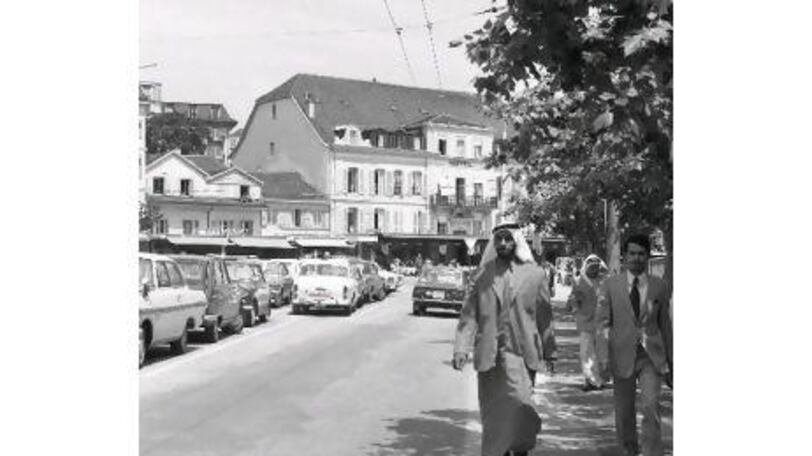
Sheikh Zayed in Lausanne, 1979.
